Timeouts, retries, backoff, and jitter
Learners understand a request as a bounded budget of time and load, and can configure timeouts, retries, backoff, and jitter so recovery from transient failure never exceeds that budget or amplifies it into an outage.
The problem
A network call fails ambiguously: a caller may time out after the dependency already completed the work, while synchronized retries can turn a brief slowdown into a sustained outage.
After completing this topic you will be able to:
- Allocate an end-to-end request deadline across a caller and dependency, including time for retries, rather than applying unrelated per-hop timeouts.
- Classify a failed attempt by evaluating prior-outcome certainty, repeat safety, plausible transience, remaining completion budget, and retry ownership separately — never by status code alone.
- Choose a bounded retry policy — maximum total attempts, capped backoff, and jitter — that fits a latency budget and protects a recovering dependency.
- Diagnose load amplification from telemetry by relating initial request rate, retry rate, timeout rate, dependency latency, and rate-limit responses.
- Implement cancellation and observability so abandoned work stops where possible and operators can distinguish dependency failure from an unsafe retry policy.
- Distinguish a deadline from a per-attempt timeout, and total attempts from retry count.
- Explain why a timeout is usually an unknown outcome rather than proof that a dependency did nothing.
- Trade off no retry, fixed-delay retry, and exponential backoff with jitter against reliability, latency, and operational complexity.
Overview
A request is a finite budget of time and load. Every attempt consumes part of both. Retry only an operation that is safe to repeat and plausibly failed for a transient reason, keep every attempt and every delay inside one bounded completion budget, and make retries less synchronized than the failure that caused them — otherwise a brief dependency slowdown becomes a self-inflicted outage.
Given an uncertain dependency outcome, the layer holding the retry has to answer one question: retry, reconcile, return pending, fail, or hand the work to an asynchronous path? Status code alone never answers it — that decision needs the prior outcome, repeat safety, plausible transience, remaining budget, and who owns the retry, considered separately.
01
Core model
- Bounded completion budget
The absolute latest time — or work window — by which an operation must complete, fail, or return a known pending state, from the caller's perspective. It is usually a request deadline, but it can equally be a queue visibility window, a worker lease, a workflow deadline, or a business freshness requirement. Everything else in this topic — timeouts, attempts, backoff — has to fit inside it. This guide uses an interactive request deadline as its running example because its main scenario is checkout, but the same reasoning applies to any of the other forms.
Definition
- Timeout
A bound on how long one specific attempt waits before giving up. A timeout is a property of an attempt; a completion budget is a property of the whole operation. Confusing the two is the single most common bug in this area: a per-hop timeout chosen without reference to the caller's remaining budget can quietly outlive it, leaving downstream work running after no caller is still waiting. A timeout expiring is not proof that the downstream work stopped — see Cancellation and deadline propagation below.
Definition
A useful way to hold the model in your head: total attempts is the initial call plus every retry, not "the number of retries." Saying "three retries" without saying whether that means three calls or four is how load estimates go wrong.
- Attempt — one invocation of a dependency. The first call is an attempt, not a "zeroth" retry.
- Retry eligibility — never decided by status code alone. It is six separate questions, walked in order below.
- Backoff — intentional delay before a retry, usually increasing after each failure and always capped, so it cannot grow to consume the remaining budget on its own.
- Jitter — randomized variation added to that delay so many callers retrying after the same failure don't arrive back at the dependency in a synchronized wave.
The retry decision, in order
Answer these in sequence. Any "no" or "unsafe" ends the sequence at a non-retry outcome — it does not fall through to the next question.
- Is there enough completion budget remaining to wait, attempt, and handle the response? If not, stop now — retrying anyway spends the remaining budget on a call that will also fail from lack of time.
- What is known about the prior outcome? Success returns success. A permanent failure (validation, auth, an explicit do-not-retry response) is surfaced and never retried. Everything else is either plausibly transient or outcome-unknown, and continues to the next question.
- Is another execution repeat-safe under the dependency's documented contract — naturally idempotent, or covered by a receiver-side idempotency mechanism that this caller has actually confirmed? If not, stop: reconcile, return pending, or fail rather than guess.
- Is the failure plausibly transient — a connection reset, a timeout, a documented retryable status — rather than a stable condition another identical attempt cannot change?
- Does this layer own the retry budget for this operation, or might a client, SDK, gateway, mesh, queue consumer, or workflow engine downstream already be retrying it? See Nested retry ownership below.
- If every prior check passed: wait a capped, jittered backoff while budget remains, then retry. If any check failed: choose the safer non-retry outcome — fail, return pending, reconcile/status-check, or move to an asynchronous path.
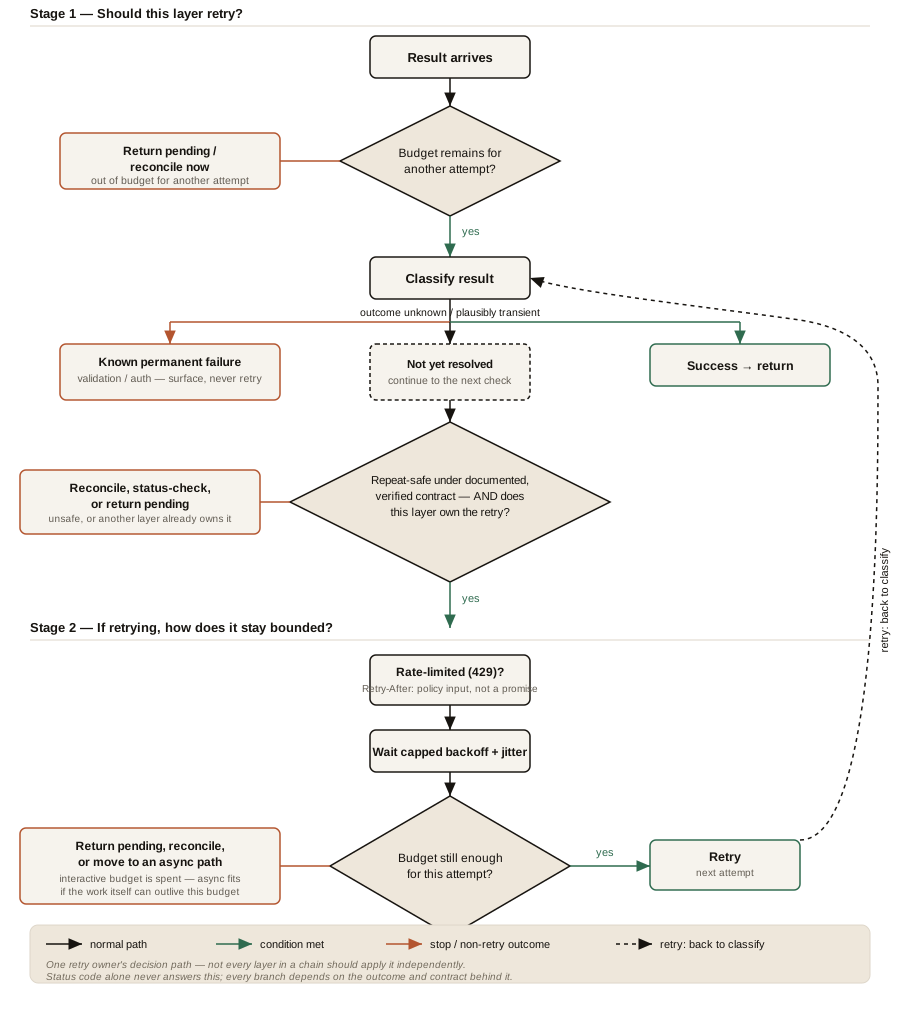
Stage one: does budget remain for another attempt — if not, return pending or reconcile. Otherwise classify the result: success returns directly, a known permanent failure is surfaced and never retried, and an outcome-unknown or plausibly transient result continues to one combined check — is repeating the operation safe under the dependency's documented contract, and does this layer own retries. Either a no routes to reconcile, status-check, or return pending. Stage two applies once stage one says retry: confirm Retry-After fits policy and the remaining budget when the response was rate limited, wait a capped backoff with jitter, then recheck budget before the next attempt — with no budget left, return pending, reconcile, or move to an asynchronous path if the work itself can outlive this budget.
Why timeouts trigger overload: longer dependency latency raises the chance an attempt times out; a timeout triggers a retry; retries add to the dependency's concurrency and queueing; more queueing raises latency further. This positive feedback loop is a retry storm, and it is the main reason retry policy is a capacity decision, not just a client-side convenience.
A small timing-budget example, as a conservative planning model: a caller has an 800 ms deadline and reserves 150 ms for its own validation and response handling, leaving 650 ms for the dependency. A 300 ms per-attempt timeout and a single retry with up to 100 ms of backoff fit inside that 650 ms (300 + 100 + 300 = 700 ms — already tight). A second retry would not fit; the policy has to stop at one. Treat this as a floor, not an exact guarantee: a real budget may also need to absorb connection-pool wait or connection establishment, DNS or service discovery, network transit, dependency queueing, response decoding, and cancellation cleanup — and a per-attempt timeout expiring does not necessarily stop downstream processing that the dependency already accepted.
02
When to use it
Bounded retries are the right tool when all of the following hold:
- The failure is plausibly transient — a connection reset, a timeout, or a dependency-reported retryable status (a documented 5xx class, or 429 with
Retry-After) — not a validation, authentication, or authorization error. - The operation is safe to repeat: it is naturally idempotent (a read, a
PUTof full desired state), or the receiver documents and correctly implements a durable idempotency mechanism the caller has verified applies here. - A known, remaining completion budget exists that can absorb both the delay and a genuinely useful additional attempt.
- The failure semantics are clear enough to say, in advance, which responses are retryable and which are not.
- This layer is the documented retry owner for the operation — see Nested retry ownership below.
Typical fits: service-to-service calls inside a request path, and external APIs that document retryable status codes and rate-limit behavior.
03
Nested retry ownership
Retries can happen independently at several layers of one call chain: an application client, an SDK, an API gateway, a service mesh sidecar, a queue consumer, or a workflow engine. Each layer typically has no visibility into whether another layer already retried. A local "maximum three attempts" setting does not protect the dependency if the SDK underneath it also retries — the two policies compose, they don't share a budget.
Example (an upper bound, not a universal formula): an application configured for three attempts, calling through an SDK also configured for three attempts, can produce up to nine physical calls to the dependency for one logical request — each application-level attempt triggering a full SDK-level retry cycle underneath it.
There should be exactly one named retry owner per logical operation — the layer responsible for deciding whether, when, and how many times to retry — or, where multiple layers must each retry, a documented shared retry budget across them. Everywhere else, retries should be disabled or reduced to a single attempt.
04
What it costs
Retries are never free, even when they work:
- Tail latency grows. A caller that retries once roughly doubles its worst-case latency for that operation.
- Load multiplies, at this layer alone. If 1% of calls need one retry, this layer sends roughly 1% more traffic to the dependency — before any other layer in the chain adds its own retries on top; see Nested retry ownership above for how quickly that compounds.
- Duplicate-risk exposure grows with every additional attempt on a mutation, even a nominally idempotent one, if the idempotency mechanism itself has a gap — see Idempotency keys are conditional, not absolute below.
- Diagnosis gets harder. An aggregate success-rate metric can look healthy while retries silently absorb a real degradation; the retry-to-initial-call ratio has to be tracked as its own signal.
05
When not to use it
Do not apply a default bounded-retry policy when:
- The mutation has no confirmed receiver-side deduplication and no safe reconciliation path, and a duplicate side effect (a second charge, a second email) would be harmful.
- The remaining completion budget cannot fit both a delay and a genuinely useful additional attempt — retrying anyway just spends the budget on a call that will also fail from lack of time.
- The dependency has already reported a permanent failure: validation, authentication, authorization, or an explicit documented do-not-retry response.
- The caller has already cancelled — the result no longer has value to anyone, though see Cancellation and deadline propagation below for why the downstream work may still be running.
- The work is known to be long-running. Repeatedly extending timeouts to simulate asynchronous processing is a sign the operation belongs behind a queue instead; that is the next topic in this path, not something to improvise here with retry configuration.
- Another layer already owns the retry for this operation — see Nested retry ownership above.
An outcome-unknown failure with no remaining attempt budget is not a failure to paper over with a longer timeout — it is a distinct result. Return a pending outcome, or reconcile against the dependency's own status record, and let the caller resolve it through the product's existing status path, rather than asserting the operation did not happen.
06
Cancellation and deadline propagation
A caller's deadline or timeout only tells the caller when to stop waiting — it does not prove that the downstream work stopped. Cancellation propagation (passing the cancellation signal into every downstream call and dependency) can reduce abandoned work, but only where every layer and dependency in the chain actually supports and honors it. Treat cancellation as advisory, not guaranteed: many transports, protocols, and third-party providers accept a cancel request but do not enforce it, and some cannot be cancelled once accepted. A cancelled or timed-out mutation can therefore still need a status lookup or reconciliation afterward, because its outcome remains unknown regardless of what the local caller decided to do.
07
Practical example: checkout and a payment provider
A checkout service calls an external payment provider to create a payment intent. The mobile client needs an answer inside a 2.5-second end-to-end completion budget. The provider typically responds in 250 ms but has occasional short 5xx bursts, and returns 429 with Retry-After when its quota is exhausted.
- Idempotency keys are conditional, not absolute
A stable idempotency key is useful only when the receiver documents and correctly implements durable idempotency semantics — deduplication that survives process restarts, a defined key scope, a retention period long enough for a realistic delayed retry, request-parameter matching (so a reused key with different parameters is rejected rather than silently misapplied), and a defined replay-response behavior. A client-generated key alone proves nothing; it is only as good as the contract the provider publishes and the caller has actually confirmed. A timeout or cancellation still leaves the mutation's outcome unknown even when an idempotency key was sent — the key makes a *safe retry possible*, not the outcome *known*. Reconciliation or a status lookup can still be the right next step even with a key in place.
Definition
Budget allocation:
- 2.5 s total completion budget, inherited from the client's deadline.
- 300 ms reserved for local validation, mapping, and response handling.
- 700 ms per-attempt timeout for the provider call, subject to remaining budget.
- Maximum two total attempts — the initial call plus one retry, not "one retry" left ambiguous.
- Capped exponential backoff with full jitter between attempts:
delay = random(0, min(100ms × 2^(retryIndex-1), 400ms)).
Retry eligibility for this call: retry only on connection failures, a timeout, selected documented 5xx statuses, and 429 — and for 429, only when the greater of the policy delay and the provider's Retry-After still leaves enough budget for the attempt to complete; otherwise stop rather than wait past the deadline anyway. Never retry a 400 validation error or a 401 credential error — those are deterministic, and another attempt would fail identically while spending budget and load for nothing.
On Retry-After specifically: treat it as a policy input and often a minimum delay, not a guarantee that the next request will succeed — it must still fit inside the caller's useful completion budget, and retrying still requires the repeat-safety and ownership checks above. Rate-limit scope varies by provider and can apply per user, per account, per credential, per endpoint, or globally, so one caller's Retry-After does not necessarily say anything about a different caller's chances. If many concurrent requests are being rate-limited at once, fail-fast, admission control, deferral, or moving the work to an asynchronous path is often better than every caller independently retrying against the same limit. Never wait past the useful deadline simply to honor Retry-After.
Two total attempts, one stable idempotency key, and a deadline that everything else has to fit inside — that is the whole policy. Everything past that is tuning.
08
Trade-offs across retry policies
| Policy | Best fit | Dangerous misuse |
|---|---|---|
| No retry, single bounded timeout | Non-idempotent operations without deduplication; tight interactive deadlines | Applying it to safe reads, where a small retry would materially improve completion |
| One retry with fixed delay | A single controlled caller, low volume, short transient faults | Fleet-wide use during real dependency overload — synchronized clients can still align on the same fixed delay |
| Capped exponential backoff with jitter | Service-to-service calls and external APIs with transient failures | Too many attempts, too high a cap, or a deadline too small to contain the resulting delays |
| Retry 429 only if Retry-After fits budget | External APIs with explicit rate-limit semantics | Ignoring Retry-After, or waiting past the caller's own deadline anyway |
| Reconcile or status-check before retrying | Outcome-unknown mutations where the provider supports idempotent replay, a stable identifier, or a status-lookup endpoint | Blind polling with no bounded budget, or treating a clean status check as equivalent to a fresh retry |
Reconciliation as a first-class alternative: when a mutation's outcome is unknown and the provider exposes a status lookup or supports safe replay under its documented contract, checking status is often safer than retrying blind — it can resolve to success, a known failure, or a genuine "still pending" without risking a second side effect. It fits best exactly where blind retry is riskiest: outcome-unknown mutations after a timeout or cancellation. It is not free, either — status-checking or reconciling without a bounded budget of its own becomes the same kind of unbounded loop retries can become, so give it the same deadline discipline. Expected outcomes are: return pending, query status now, schedule reconciliation for later, or safely replay once the provider's contract confirms it is safe to do so.
09
Common failure modes and misconceptions
10
Checklist
Before shipping a retry policy, confirm:
- The owner of the bounded completion budget is identified, and it is propagated to every attempt.
- Maximum total attempts is stated as a number, not "a couple of retries," and one layer is named as the retry owner for this operation.
- The timing budget — timeout × attempts + backoff — has been calculated as a conservative plan and fits inside the budget, with room for connection setup, queueing, and response handling.
- Failures are classified into success, permanent, plausibly transient, and outcome-unknown, not treated as one bucket.
- The operation's repeat safety has been confirmed against the receiver's documented contract, not assumed from the presence of an idempotency key alone.
- Backoff is capped and jitter is applied so retries from many callers don't synchronize.
Retry-Afteris treated as a policy input and minimum delay, honored only if it still fits the remaining budget, with rate-limit scope (per user, account, credential, endpoint, or global) understood.- Cancellation is propagated where supported, and reconciliation or status-check exists as the fallback where it is not.
- Long-running or budget-exceeding work has an asynchronous path, rather than an ever-longer request timeout.
- Observability distinguishes the logical request from its individual attempts — see below.
Observability note: track attempts as children of one logical request, not as independent events. At minimum, record: a logical request/correlation ID; attempt number and the configured cap; the retry owner/layer; the retry reason; the backoff/jitter delay applied; remaining completion budget at decision time; the deadline/timeout and cancellation result; the dependency's response category; the final logical outcome; a separate count of outcome-unknown results; a separate count of reconciliation/status-checks; and the retry-to-initial-request ratio as a monitored threshold. Keep per-request identifiers out of metric labels — high-cardinality values belong in logs or as attempt spans/events nested under one logical-operation trace, not as metric dimensions.
08
Key takeaways
Bound waiting time and recover from transient failures without amplifying load.
- Retry eligibility is separate questions — budget, prior outcome, repeat safety, retry ownership — never a single read of the status code.
- An idempotency key makes a safe retry *possible*; it does not make the outcome *known*, and it is only as strong as the receiver's documented, verified contract behind it.
- One operation, one named retry owner. Nested, uncoordinated retries at the client, SDK, and gateway layers can multiply calls to a dependency far beyond any single layer's configured limit.
- Reconciliation, a pending result, or an asynchronous handoff are as valid an ending as a retry — an outcome-unknown result with no budget left is a distinct, legitimate state, not a failure to disguise with a longer timeout.
Practice
Test what you’ve learned
Work through guided Timeouts, retries, backoff, and jitter decision scenarios. Every choice becomes a mentoring conversation, so you find out where your reasoning holds up.
PracticeReview
Revisit real examples
A calm, five-minute pass back through the concrete Timeouts, retries, backoff, and jitter examples in this guide, before they fade.
Review